
As I start writing this year in review, the first thing that comes to my mind is this holiday memory I have (and many other nerds have 🤣) from my youth: Going to see Lord of the Rings in theatres. For three years, every December, we’d get to go watch an unfolding epic saga.
The reason I keep thinking that is that I feel like I’m in my own trilogy right now.
It started last year where I said I was going to step away from WordPress. In retrospect, it ended being a bit of a fellowship of the ring moment. Everything was going well until Matt went on stage at WordCamp US. (Not too unlike Bilbo on his birthday. 😅)
And like Frodo who wished this had never happened in his time, I’ve had to decide what to do with the time that was given to me. (Probably one of the best quotes of the whole series.) That’s why I decided to branch out and set off on a journey of my own.
Now that it’s the holidays, it’s time to update you on how my own saga is unfolding. For the Lord of the Rings fans, that would put us at The Two Towers now. And, if you know the story, you’ll know that a LOT happened in that book. I feel the same way looking back at this year. It’s been quite a rollercoaster full of incredible highs, but also dark lows.
And, like at the end of the Two Towers movie, we all couldn’t wait until the next year to see how it would all end. And I think this is what makes this year in review feel the most like the movie series. It’s the first time I’ve written a year in review where I’m excited/scared to write the one next year.
Now that I’ve hopefully hooked you in, let’s see how the saga unfolded this year!
A crashing start
To start things off, I was a passenger in a car pileup in January. We got rear-ended at 70km/h (~43 mph) after hitting a car in front of us. Incredibly, no one was injured even though the air bags didn’t deploy.
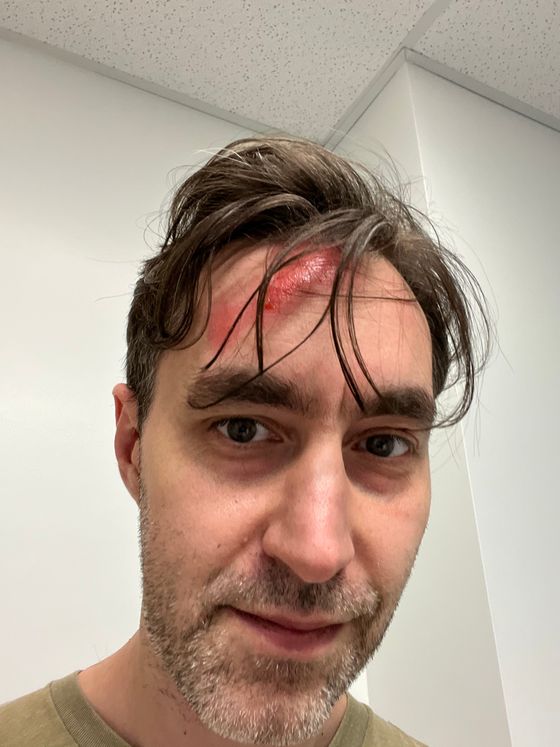
I did get a large friction burn to the forehead as you can see! That said, I was by far the one in the best shape. I was able to get out of the car immediately and help others who were in shock.
This is one reason why last year’s review came out so late.
The sneezing incident
Three weeks after the accident, I helped my partner Roberta move right after a large snowfall. I don’t remember exactly how I felt the day of. I know I wasn’t 100% and not feeling that great. But I honestly didn’t realize how close the two events were until I started writing this year in review.
This move ended up leaving me feeling quite weak in the back. I still thought I was fine, but I wasn’t really. I don’t remember when it happened, but one night I sneezed and my back blocked. I joked at the time that I just had my first old man moment. 👴🏻
I wasn’t wrong, but I think the joking downplayed the severity of what was happening. I think I might have had a disc herniation. I still don’t know to this day.
Forgetting that I’m not 20 or 30 anymore, I thought with a bit of rest I’d bounce back in no time since I’m in really good physical shape. I didn’t really adjust my weightlifting accordingly. This came back to bite back throughout the year.
First CloudFest
Not long after the “sneezing incident”, my back got some rest because I flew to Germany to go to CloudFest. I talked about my desire to go in last year’s review. I’m glad I was able to keep that promise to myself.
I wasn’t prepared for the scale of the event. (The fact that they book an amusement park should have been a clue of the scale. 😅) My largest conference up to that point had been WordCamp Europe which peaked at maybe 4,500 attendees. (I’m not sure about the official numbers.) The first day of CloudFest has over 10,000 attendees.
Things drop off pretty quickly on the second and third day. Knowing this and because of the cost of the event, I might not stay for the whole event next year. That’s if I can even afford to go.
Hackathon
To try to offset the cost of the trip, I participated in the CloudFest Hackathon. Participating in the Hackathon gave me a ticket to the event, a couple of paid hotel nights, and food was covered. It still cost me several thousand dollars USD for the flight, VIP ticket upgrade (700 euros 💸) and the extra hotel nights.
Now, I was being pragmatic participating in the hackathon. I just needed a way to reduce my costs in whatever I could. But the hackathon ended up being by far the best part of CloudFest. I’ve been promoting the event ever since and trying to get everyone I know to participate in next year’s version! (I also participated in the one in Miami which I’ll talk about later.)
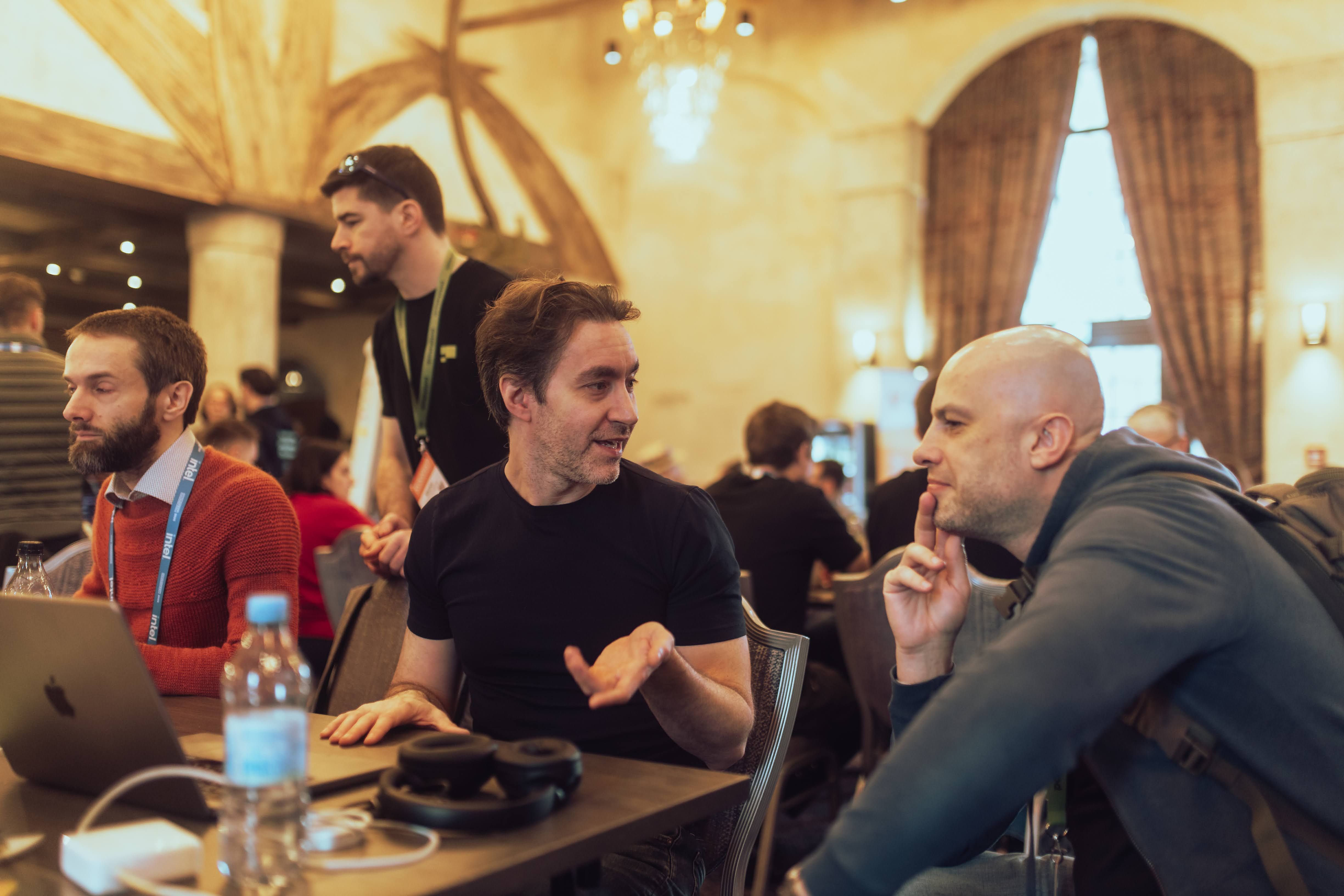
So why did I love the hackathon so much?
I think the most important one to me is that people got to see “Programmer Carl”. Everyone sees me at WordCamps where I’m super social, bubbly, running around like a golden retriever. 🐶 At the hackathon, a lot of people got to see another side that’s more serious, focused and professional. 🤓
Another person I got to see another side of was Joost. I mostly knew him as “Party Joost” (like me!) or “Business Joost”. It was so awesome to see his programmer side. I even joked about it on LinkedIn 🤣
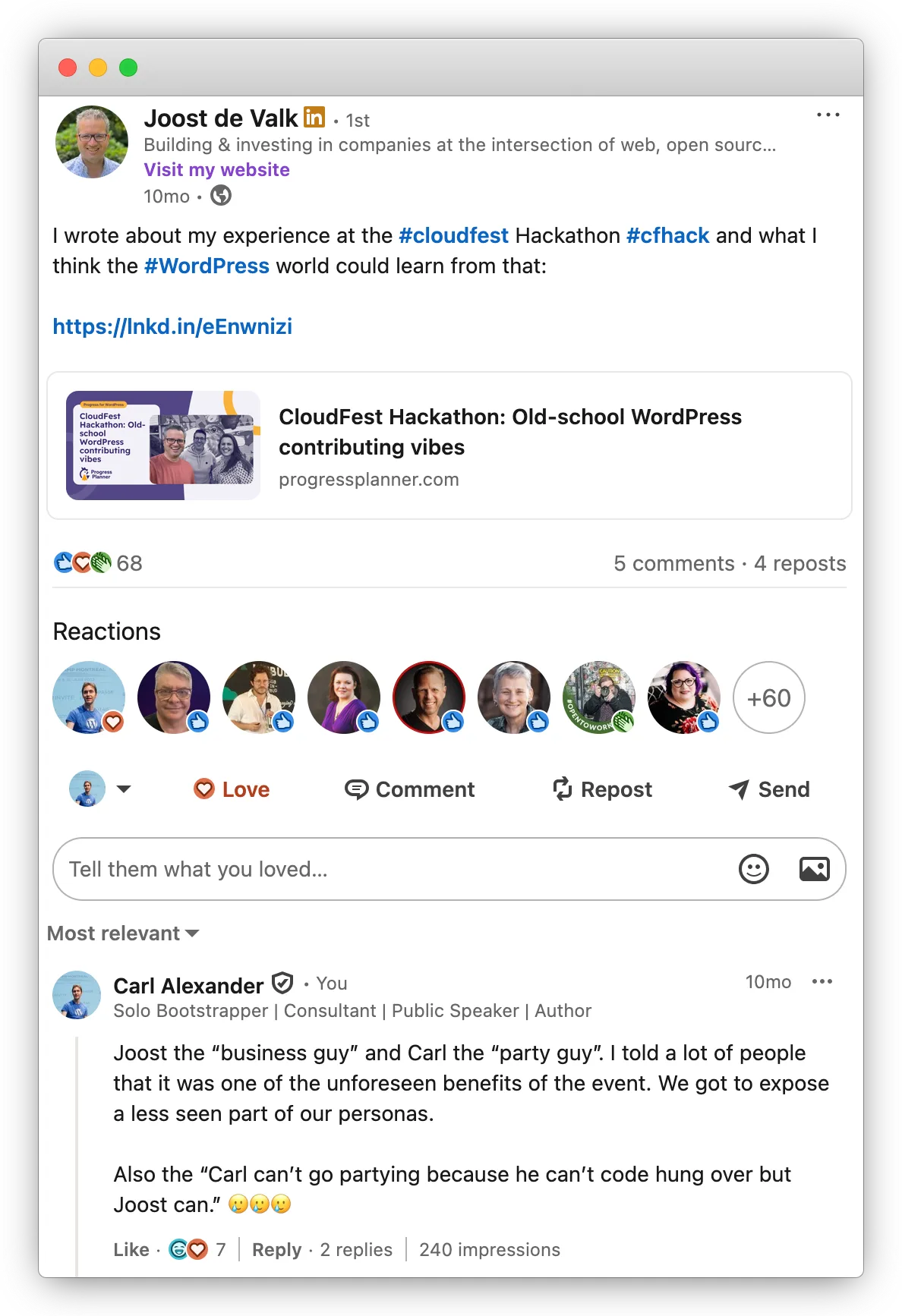
He also did a write-up on his experience which I loved. The hackathon did have that old school WordCamp vibe to it. It was just an awesome atmosphere where everyone was having a great time coding together. 💖
Conversations around neurodivergence
I also had some of the most fun, beautiful, deep, personal conversations on neurodivergence during the hackathon. The highlight was talking with Roan de Vries. Hearing his journey and the things he figured out on his own that took me so long to figure out was so inspiring. (I mentioned it a few times to his dad. 😅)
It’s a bit hard for me to remember everything we talked about after nine months. (It honestly feels like forever ago.) I shared a lot of what I’d figured out in 2023. The relationship I had with alcohol and my autism. How I came to realize that I used it to mask.
I had other wonderful conversations as well with other people. These conversations felt like great bonding moments to me and I don’t wish to diminish them. But the ones with Roan about how I use alcohol were very important to me.
And, as we’ll see shortly, they would take on a completely different significance.
Was it worth it?
I wish I could say that all the money I paid to go to CloudFest was worth it. I spent about 7% of what I make all year to go there even with everything the hackathon gave me. It was ridiculously expensive for me.
I loved the hackathon and I’ll be applying again for the 2026 version. They cover enough that I could go and just need to cover the flight. It’s an amazing deal for such a wonderful event!
As for the rest of CloudFest, I’m not sure. I doubt I’ll stay for the whole thing whatever I decide. The reality is that I had a few meetings about Ymir and they were on the first day. On top of that, the anti-US sentiment was quite high when I was there. Ymir is a solution for Amazon Web Services (AWS) and a lot of European executives wanted nothing to do with hyperscalers right now.
I was also not able to get any consulting work. So I spent a lot of money and essentially made none. I did get an amazing lead for Ymir that I can’t share, but nothing panned out. Insert sad trombone
Grieving a brother
This section will need a bit of context. My family is very small. I don’t have any cousins or extended family. I have both my parents, an aunt, a sister and a niece. That’s it.
On April 16th this year, I received a text from one of my closest friends, “My brother just passed away.”
This friend’s family is like my extended family. I’ve known his baby brother since he’s five. I’ve spent the last decade doing Christmas Eve at their house. His cousins are the closest thing to cousins I’ll ever have. His mom calls me her adoptive son. (I’d be the eldest of the three. 😅) They are the definition of chosen family.
That day, my baby brother died too.
The heavy price of masking
The official cause of death was heart failure. The real cause of death was alcoholism.
For those reading this who’ve known me for a long time, I used to drink and party a lot more. Sure, we’re older and all that, but I know exactly the moment when my relationship with alcohol began to change. It was Christmas morning 2018.
Another thing you might not know about me is I have condition called “essential tremors” which cause my hands to shake. It’s not always noticeable, but you can usually see it towards the end of a WordCamp when I start getting physically exhausted and sleep deprived. That Christmas morning he was shaking more from delirium tremens from the overnight withdrawal than I ever have from my condition.
Seeing that shook me to my core.
It shook me so much because I knew why he used alcohol. It was the same reason I used alcohol. He used alcohol to mask. (That’s why those conversations at CloudFest were so important.)
Like me, alcohol let him be his weird self, share and have crazy stories, be social, feel accepted. The difference between us is that I learned to love myself and see that my uniqueness was not something to feel ashamed about. On the contrary, I’m so proud of who I am, of my personal growth to get there, of my willingness to live by my virtues and not by others.
I told his mom, “I wish he’d known he was loved without the alcohol.”
Death of a stranger
There is something about grief when someone has a substance abuse problem. I wouldn’t know, but I assume it feels a bit like losing someone to something like Alzheimer’s disease. The person they were is slowly replaced with someone else.
They have good moments where you see the old person that they used to be. But more often than not, it’s someone you don’t recognize anymore. In this case, replaced with someone that doesn’t feel safe or good to be around.
The fun and happy baby brother I knew had been long gone before he passed away this year. I’d been mourning him for years already. I’d been talking about it in therapy, with his brother, with his cousins.
It doesn’t change that it hit me hard that he’s gone. In one way, you know the person that just left wasn’t really the person you knew. But, at the same time, they’re still gone forever now. There won’t be a redemption arc for them.
That said, this whole idea of a redemption arc, built on hope, is difficult and full of paradoxes for me. A part of me hopes he found peace now. And, despite the intense grief they have and are still suffering, I hope his family will also find peace in the long run.
But for all that to happen, he had to pass away.
The midlife catalyst
His passing also triggered a lot of survivor’s guilt. I couldn’t make him figure all this out himself. We talked, he did rehab twice and all that. But I could have ended up like him and I didn’t. And that part is hard to live with.
I wish I could say that survivor’s guilt was the only thing that his death triggered. But that wasn’t the case. His death also set in motion a journey that I’m still on and will be on for years to come: the journey through midlife.
Midlife hits us all differently and at different times. I’ve been quite blessed in my life that I haven’t had a lot of experience with mortality. It’s been the usual stuff like grand parents and family friends with a few exceptions.
It’s not that those deaths didn’t matter. They did in subtle and deep ways. But this one hit different for various reasons. It felt different to lose someone who was like a brother to you, who was younger than you, who you always thought would grow old with you.
It’s been hard to see how it affected my friend’s mom who is like a mother to me. It’s impossible for me to not think of Théoden saying, “No parent should have to bury their child.” (I wasn’t kidding with the Two Towers reference 😅)
Going through midlife is an important topic that I’ve spent a lot of time on this year. For now, I just want to mention that this was the catalyst for it. I’ve done a lot of work that I’m proud of already. I have a lot of thoughts and things I want to share. But I’ll leave it for a dedicated section later in the review.
Wedding in Brazil
Almost a week to the day after all this happened, I was flying off to Brazil for three weeks. My partner Roberta’s brother was getting married and we’d planned this trip for over a year. I left not knowing if I’d be able to make it to the funeral.
Due to various circumstances, the funeral ended up being the day after I came back. But I didn’t know at the time when his funeral would be or if I’d get to attend it. That brought random waves of grief at times.
That said, I think leaving was the best thing I could have done at the time. I can’t speak for others, but, for me, it’s very useful for me to be able to just go away somewhere for a while. The physical distance and being immersed in another environment provides a disconnect that I’m not able to replicate easily at home.
Meeting a new family
Definitely, one of the most memorable parts of the trip was meeting Roberta’s family and her brother’s in-laws. (Me and his father-in-law really hit it off! 😅) I’d only met Roberta’s mother and stepdad once when we started going out.
I mentioned earlier that I have the tiniest of families. Well, her family is huge! There’s still four generations alive which is just mind blowing to me. Roberta’s niece and daughter have a great grandfather. (A badass former paratrooper to boot! 💪🫡) Meanwhile, both my grandfathers died in the 1960s, twenty years before I was born. Forget about my great-grandfathers!
On my birthday, her daughter arrived from Australia where she lives with her dad. I haven’t interacted with a teenager in what feels like 20 years. I wasn’t quite prepared for how much fun it would be!
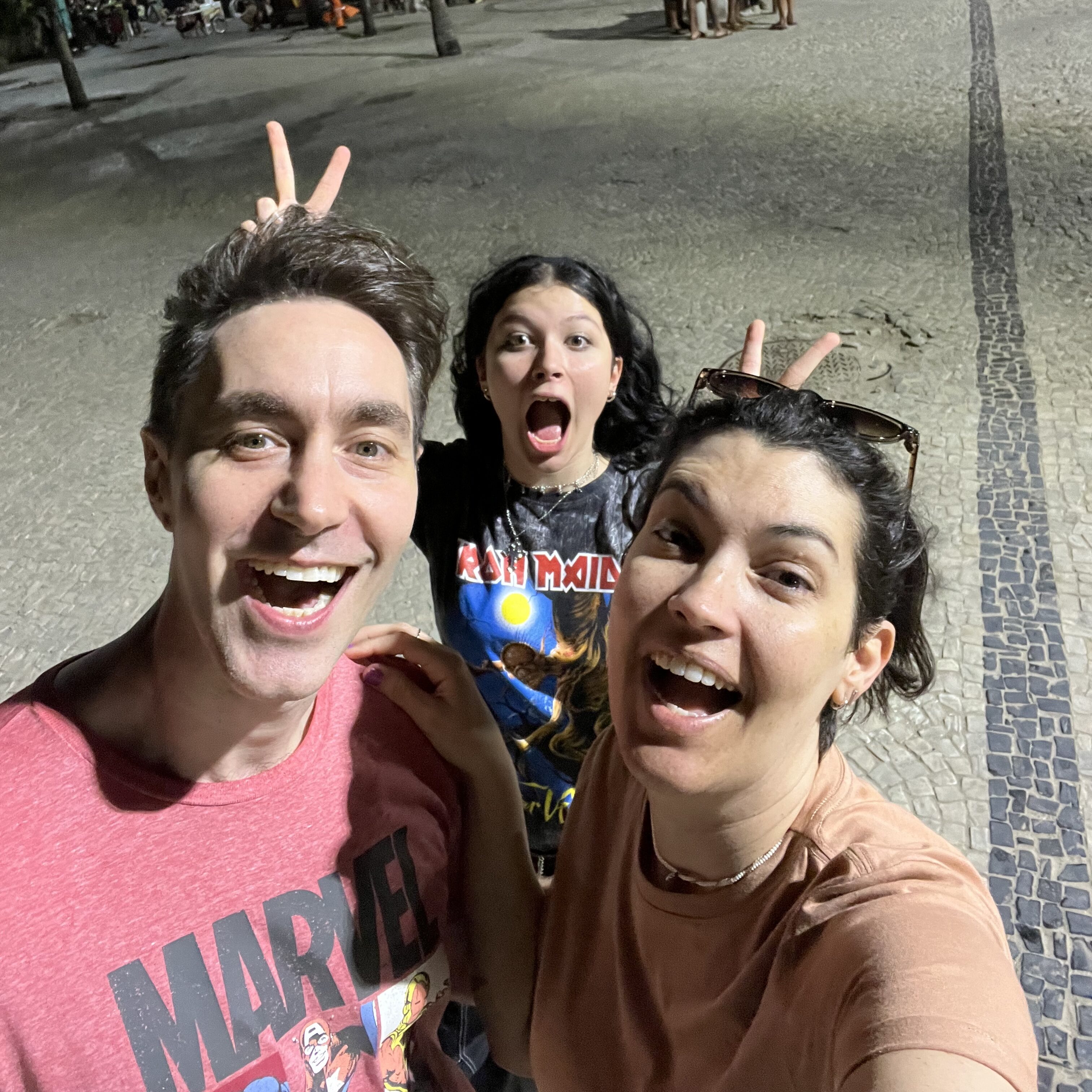
It was such a delight to meet her and it’s a shame she lives so far away. She has such a huge personality and she’s a real artistic and creative spirit. She loves her “menagerie” of nerds back home. I’m pretty steeped in video game culture and all that so we had no issues communicating because of that!
We had a really swanky Airbnb in Rio de Janeiro for most of the trip. Most Airbnbs nowadays are just apartments designed and built to be Airbnbs. But this one was a real apartment that a mom and daughter lived in. (They split their time between Rio and São Paulo.) But her daughter had a cool bedroom with a pink streamer chair that Roberta’s daughter claimed from me the moment she arrived. 🤣
Living in that Airbnb was just a wonderful family experience which I haven’t had the chance to have in my life. I am grateful for it. 💖
Remote working
One of the reasons for having a fixed Airbnb during the trip was that I needed to work while I was there. (I honestly can’t remember when I took time off last.) Our Airbnb was in Flamengo which is a nice neighbourhood by the beach. (We did not go to the beach there though. 😅) Flamengo is also quite safe by Rio standards.
This was important because I wanted to be able to have a routine like I do on my long trips. I wanted a neighbourhood where I could safely walk outside. I was going to the gym, doing groceries, and all that.
The Airbnb had a great looking office too. I did some livestreams for Ymir in it. (I liked the one I did with Toby.)
Overall, I really enjoyed my time there. It’s hard for me and Roberta to imagine not going back there if we went back to Rio!
The wedding
The wedding itself was also amazing. Definitely, the most expensive wedding I’ve ever been to! They had a wedding planner and assistants, a dedicated social media account, drones flying around filming, a team of photographers, the whole thing!
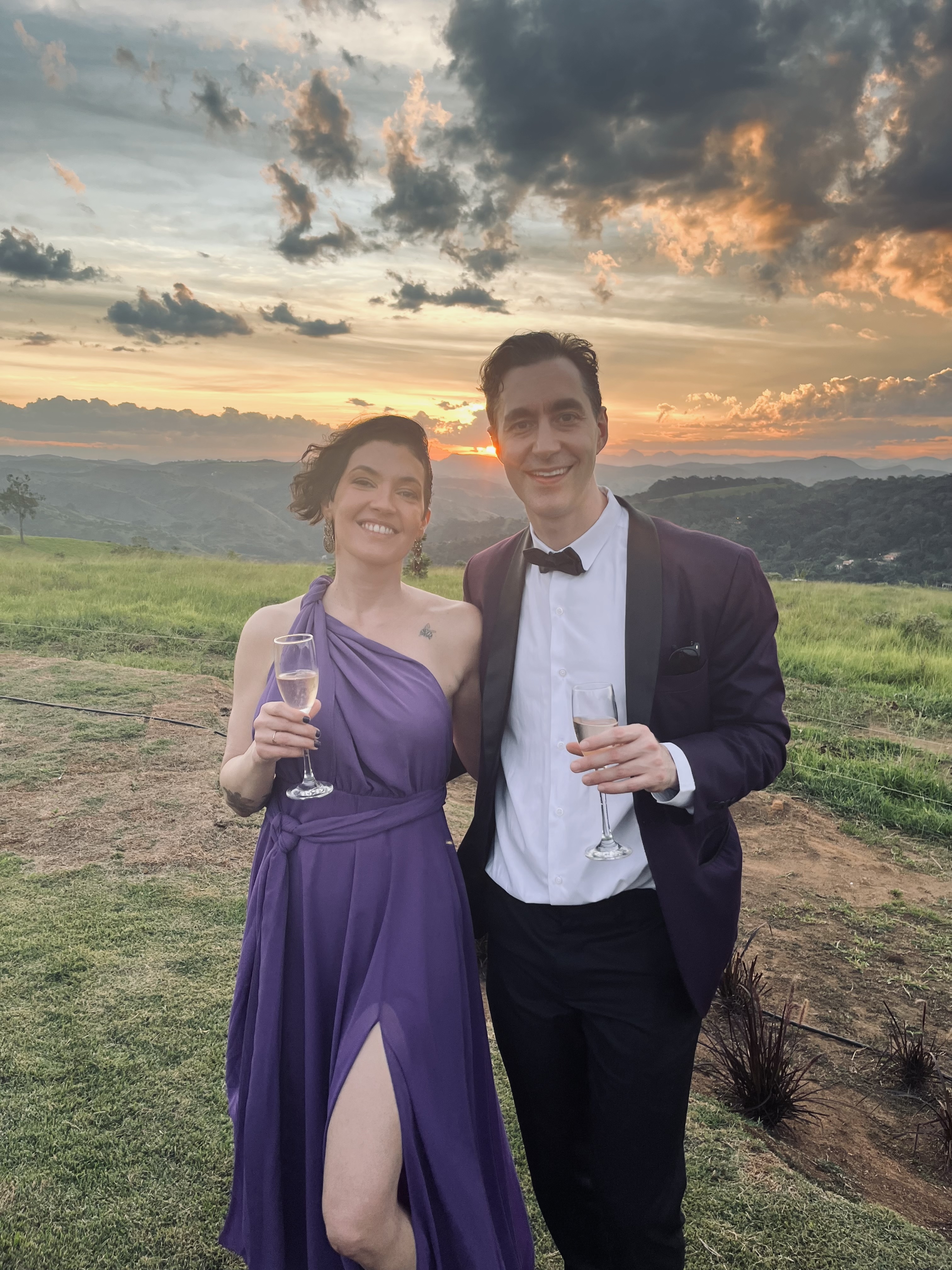
The venue itself was magical. It was a few hours out of Rio in the small state of Areal. That area is very mountainous and the wedding was at the top of a mountain. It was definitely a challenge getting there! But the view was totally worth it since the wedding was at sunset and the vista was breathtaking. Me and her were dressed in purple and looked fantastic!
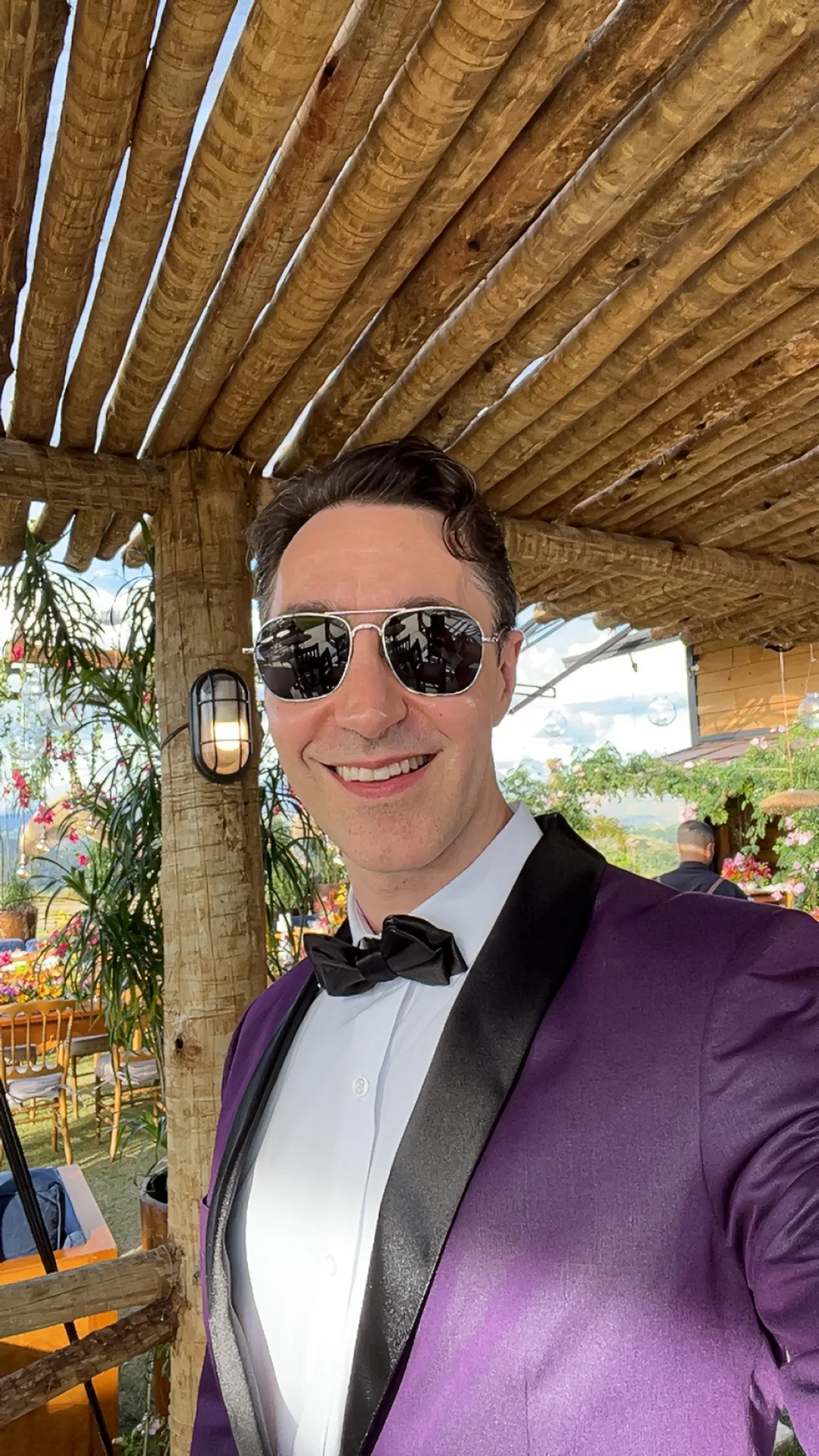
I never usually do selfies, but I randomly took one when I got to the wedding. It turned out so good that I sent it to Roberta saying, “This is the best I’ll ever look 🤣” So if you noticed a new profile picture of me everywhere, it was from the wedding! 😅
Outside of that, there was a lot of dancing, singing and happiness. Weddings are always a great time! Let’s not forget the open bar too 🥂🤣
Reinjuring my back
I don’t remember the exact timeline anymore. But not long after coming back from Brazil, I injured my back again working out. I’d had no real issues in Brazil besides just feeling tired. So it came as a surprise.
This wouldn’t be the last time I injured my back this year. I took this injury more seriously. That said, I didn’t see a physiotherapist or any other specialist.
I didn’t suspect the herniated disc yet. I just took some time off the gym. I also changed my workouts to not involve my lower back as much. I figured that would be enough. Narrator: It wasn’t.
My last WordCamp Europe?
Less than three weeks after getting back from Brazil, I was flying to Basel for WordCamp Europe. This was convenient with the back injury. It gave me a full week away from the gym which I probably wouldn’t have done otherwise. 🙃
This was an eventful trip for a few reasons.
First, I almost didn’t even make it. My flight to Amsterdam was cancelled as I was sitting on the plane. We had to all disembark and leave the terminal. I managed to get rebooked on a flight two hours later only because I was one of the few people with a carry-on and I made it to the service desk first.
This wasn’t the intended reason why the trip was eventful! But it would have made the whole thing even more tragic if I hadn’t made it to Basel. The reason this WordCamp Europe was special was because I was convinced at the time that this was going to be my last WordCamp Europe.
My consulting work was drying up and I just didn’t see how I wouldn’t have to look for a job in the fall. While I have a lot of connections in the WordPress world and maybe I could have taken a WordPress job, I can’t say my heart was in it. (And I’ll always follow my heart if I can.) I love the WordPress community, but I don’t really want to work in WordPress.
Maybe this sounds a tad dramatic, but everything felt (and still feels) so uncertain. As I’m writing this, I still don’t know where I’ll be next year. I don’t think it was my last WordCamp Europe in the end (as we’ll learn why soon), but I really didn’t know at the time. All I wanted was to just spend time with my European WordPress friends one last time. 🥹
I got to hang out with Alex (as he wants to be known) and talk about life until the sun rose one more time. (We did it at CloudFest too. 😅) I got to tell Remkus again how proud I was of Roan especially after what had happened after CloudFest. (Not without ugly crying in the process 🤣) Alain gave me a stern talking to that only someone who really cares about you would give you. I got to drink and bar hop in the streets of Basel with everyone.
I honestly don’t remember much else from the event. I wanted to see my friends and connect with people. I didn’t want to do any business or talk about Ymir much. I wanted it to be like how WordCamps used to be for me before COVID.
And that’s what I did. I loved it. If this had been my last WordCamp Europe, I would have been a great send off and I’d have had no regrets. 💖
Amazing summer ☀
So on one hand, I went to WordCamp Europe not knowing what the future held for me. On the other, the present was pretty great. Summer was here. Montreal summers are always so full of energy after the months of winter cabin fever.
I also had work coming in. So while my future prospects were uncertain, I was still making money. I actually had periods where I thought I might make it through.
That changed as the summer progressed. Work dried up and I lost a lot of clients due to various reasons outside my control. (They would have all continued working with me.) But I’d banked a good amount of money so I wasn’t worried too much about it yet.
I wanted to enjoy my summer which I did!
BuiltFast
A few weeks after coming back from WordCamp Europe, Justin Mazzi announced on LinkedIn that he’d co-founded a new company called BuiltFast. For context, Justin was CTO of A2 hosting which was acquired in January and then became hosting.com. We’d been in touch about doing consulting work back then, but, with the acquisition, things fell through.
I just sent him a quick congratulation via DM. We had some really good chats at WordCamp US last year. I figured maybe I could help him with things at his new company since I have a really good skill set for hosting company work. (I’d also tried to do the same with hosting.com, but they weren’t interested.)
Well, that’s not exactly what happened! Not long after I DMed Justin, I got on a call with him and Paul Carter, BuiltFast’s CEO who’d also been COO at A2. So much has happened since that first call. I don’t remember it at all.
That said, I think it was just a get to know you call. Apparently, Paul had been following my journey with Ymir and reading my reports. I sent a follow up email thanking them and saying it was great chatting. But that’s all I have about that first call.
At the time, I figured I was just getting to know a new consulting client. But this ended up being the first call of many. I wasn’t getting to know a new consulting client. I was getting to know Ymir’s new business partners.
Puttering on Ymir in August
So August rolled around. I’m in full partnership negotiation with BuiltFast at that point. Most of my consulting work has dried up, but I have money banked up for a month or two. I decided to not worry about consulting work and just work full time on Ymir for about a month and a half.
All I’ve ever wanted was to work on Ymir full time. I talk about this post, “My product is my garden“, all the time. I called my livestream “Puttering on Ymir” because of that post. My permanent Discord status is “Puttering on Ymir”. You get the idea! 😅
It’s been my waking dream to work on my product full time. I wasn’t willing to do it at any cost so that’s why I haven’t been successful yet. But my entire professional life has been singularly focused on achieving that goal. And this will continue until I either succeed or die. (This is what it’s like to be “The man in the Arena” for me.)
With that said, in August, I got to live my dream, if only briefly. When you dream of something for so long, it sometimes takes this almost mythical property. You imagine something and the reality can often be different.
A part me always wondered whether the dream was real or not. Well, it was real. August was probably one of the happiest months I’ve ever had. I got to work on my product garden and it was all I imagined it to be. 🥹
I was high
I think this a good time to start bringing up the topic of weed. I have to be honest that one reason I was feeling happy this summer was because I was almost always high. I don’t think it was super obvious because I was having a puff of a joint every hour or two. It was closer to microdosing.
I’ve never shied from talking about my drug use. In my 2022 review, I talked about how I used shrooms to help me deal with how I was feeling during COVID. I want to do the same here. But I’ll keep it for a dedicated section later because it’s something that spanned the whole year. I’ll just say stopped everything at the end of November and I’ll discuss why there.
But, at the time, I honestly thought it was great. I remember one evening in August where I had this overwhelming feeling of contentment. I just sat in it, thankful for the moment.
I carry that moment with me still today. That’s part of the reason I’m writing this section now. I want to acknowledge how beautiful and precious that moment was. I genuinely miss it because it was so powerful and almost spiritual.
I was worried it might impact my work. But honestly, it didn’t. It helped focus and get a lot of good work done. (I’ll explain why later.)
Third back injury
I was still riding high (intentional pun 🤣) from the summer going into September. I felt strong, my workouts were going well in August. On Wednesday September 3rd, I was tired and didn’t feel quite 100%, but decided to do my work out even if I did it lighter and shorter. (I’ve always done that so it wasn’t an unusual decision.)
After my first exercise, I felt a slight pain in my back. I just lowered my weights and kept going. I got to a leg curl exercise later and then the pain just blew up. My back started locking. I just stopped my workout immediately and rushed home as fast as I could. (I had trouble walking.)
My back ended up being locked for 48h. I couldn’t straighten it at all. I was literally stuck in an old man back curve. The pain was excruciating. No position gave me any relief.
Physiotherapy
By Saturday, I was ok enough to walk to a nearby physiotherapist. Seeing them helped a lot with the acute symptoms. They used electrical muscle stimulation and it unblocked my back. But it wasn’t clear what the underlying issue was.
Even during the assessment, they tried so many movements that didn’t cause pain. They eventually found it. So, at least, I didn’t feel crazy.
This is where we started talking about the herniated disc possibility. That said, there was no way to know without getting a MRI. This wasn’t going to happen without me paying for it at a private clinic. It’s hard to get a MRI through the public healthcare system and, even if I managed to get a doctor to agree to one, the wait time is almost a year.
Discouraged
The whole incident left me really bummed out. One thing I haven’t mentioned until now is that I’d already been doing a ton of back accessory work for over a decade.
My mom’s back had locked when I was in my early 20s. She’s a dentist and was bent over all the time for work. This made me self-aware of work hazards related to back pain. I realized I had the same risk working and playing on the computer all the time.
So early on in my weight lifting journey, I added a ton of back accessory work. I added more after I hurt my back again at the beginning. In fact, some of the exercises the physiotherapist suggested to me I’d done as warmup exercises the day I’d injured my back.
I don’t think I saw the best physiotherapist if I’m honest. They got me out of the hole, but they weren’t going to help me not fall back again in it. But it was frustrating to get prescriptions for exercises I was already doing.
Not giving up on my back
I don’t remember how, but I stumbled on this video one night:
Sometimes things happen for a reason. This was the video I needed to see when I was feeling so low. What was important about it for me was the focus on personal empowerment and perseverance.
I’m going to live the rest of my life with my body and this back. No one knows it better or will ever know it better than I will. I should be curious, patient and willing to take the long term view on it.
I’ve joked a lot that I want to be as cool as this 70+ year old Japanese man that was benching 135+ lbs at my powerlifting gym in Tokyo. To me, it was an incredible to see something like that. (I wasn’t the only one because people would take selfies with him a lot 🤣)
This won’t happen if I’m not willing to work through major setbacks like this.
Rebuilding my back
This video jolted me back to life. I’d stopped weightlifting, but kept exercising. At the time, I was mostly taking walks to apply the whole “Motion is lotion” thing.
I signed up for Low Back Ability (the community from the video) for a month. I started going back to the gym. I still stayed off the weightlifting. Instead, I did the low back ability program and some incline treadmill walking at a brisk pace.
This immediately made me feel better.
I felt very disregulated not being able to lift weights. First, it’s a core part of my life and daily routine. (For context, next year will be my 20th year weightlifting.) So not being able to do something that was this central to my life was hard.
But another key insight came from another autistic friend who was discussing weighted blankets and other nervous system regulating tools that autistic individuals use. They pointed out that I’d probably been using weightlifting to regulate my nervous system via the parasympathetic nervous system. I’d never thought about it, but it made sense. It was another item in the long list of things I’d unconsciously done to manage my autism over the years.
The other thing I did is buy the book, Back Mechanic. Stuart McGill is a leading researcher in spine biomechanics. He’s famous for the “McGill Big 3” which are core back rehab exercises. (Also talked about in the book.)
That said, this was the perfect book for me. My passion for weightlifting comes my autistic special interest in biomechanics and nutritional science and how to apply it to myself. (I’m an engineer through and through 🤣) The book teaches you how the spine works and how to do your own self-assessment and rehabilitation. This was exactly what I needed because no one will know my back better than me.
I won’t come back to this again. So I’ll just wrap up by saying that it’s been working very well so far. I’m continuing to rebuild my back, but I’ve also restarted weightlifting gradually. I’ve changed my workout to remove all spinal compression exercises such as deadlifts and military press.
Fall acceleration
I’m really glad I took it easy and enjoyed my summer. Not only did I hurt my back, but things got really busy for me. In fact, it hasn’t really stopped since then.
BuiltFast partnership
In September, negotiations with BuiltFast were in full swing. This was a very stressful period for me. I’d never negotiated a business partnership (or any type of partnership 🤣) before. I had to quickly get up to speed on a whole lot of topics.
There’s the usual things like getting all the legal stuff right. But I also didn’t know what I could ask, what I could get, etc. The stakes felt so high and there was so much I didn’t know.
To Paul’s credit, he was kind and empathetic during the whole process. There were some curve balls. But we’d always get on the phone right away and just talk things through. (One specific Saturday in September, I think I spent a total of 6h on various calls and talking in Slack. 😅)
I also had to spend a tremendous amount of energy to stay grounded in the present. When an opportunity like this shows up, it’s easy to think that “you’ve made it.” It feels like winning the lottery and you start thinking about how different your life is going to be.
But you’re living in an imagined future. It’s not real. The only thing that’s real is what’s happening right now and the work that you’re putting in.
I’ve always been good at that. But this was like playing on a new difficulty level. It just required so much more out of me to stay above water. That’s why I wanted the partnership exclusivity more than them almost. I need time to recover before I do this again.
We got the agreement wrapped up at the start of October. I remember immediately feeling so much relief. Most of my stress went away. But I still have to work hard to stay in the present. 🙃
WordCamp Canada
So pretty much after the partnership agreement, I left for Ottawa for WordCamp Canada with Roberta. It was her first WordCamp experience which was super exciting! She got to meet a lot of people and friends that I speak about all the time. (Special mention to Courtney who just blurted out, “You’re real!” 🤣)
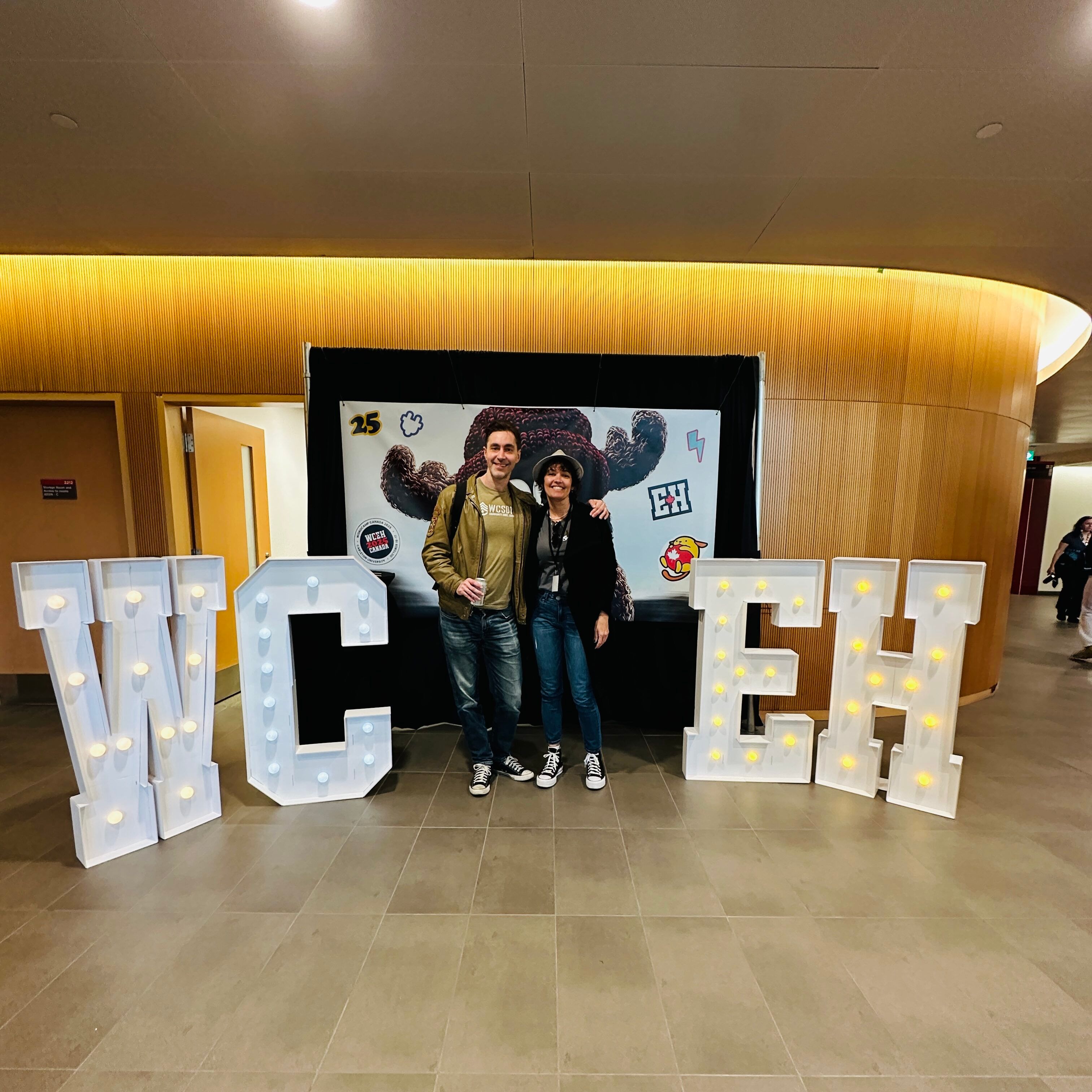
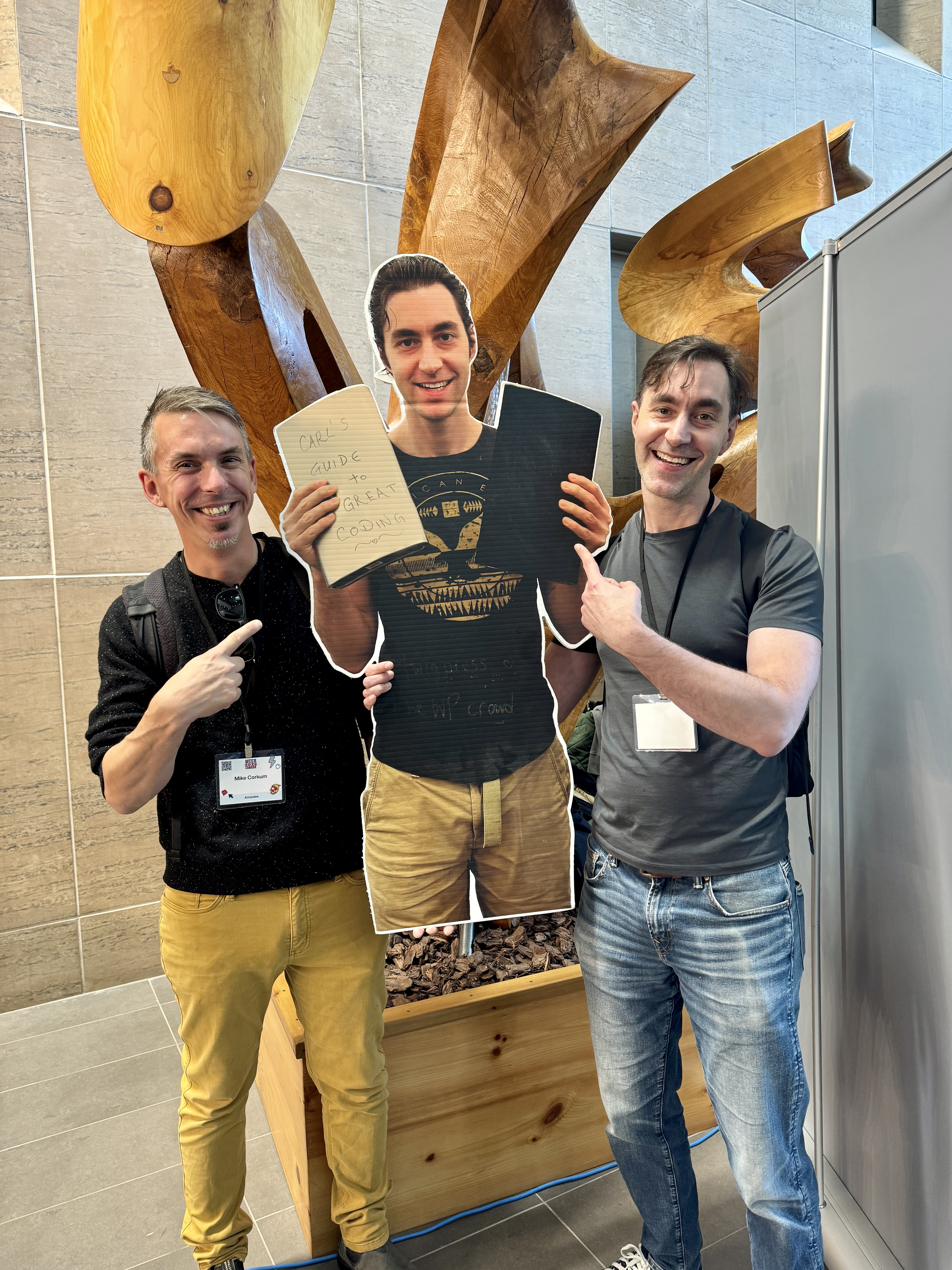
WordCamp Ottawa is where CarlBoard came to be. (You can read about it in my 2016 review.) So I had to bring CarlBoard back to where it all began! I tried to recreate the original picture that I use on the site. 😅
WordCamp Canada was where I was testing out the next iteration of my serverless WordPress talk. It was weeks of work on top of the BuiltFast partnership negotiations. The reason it was so much work was because I was working on the new Ymir marketing material. I was using the talk to test it.
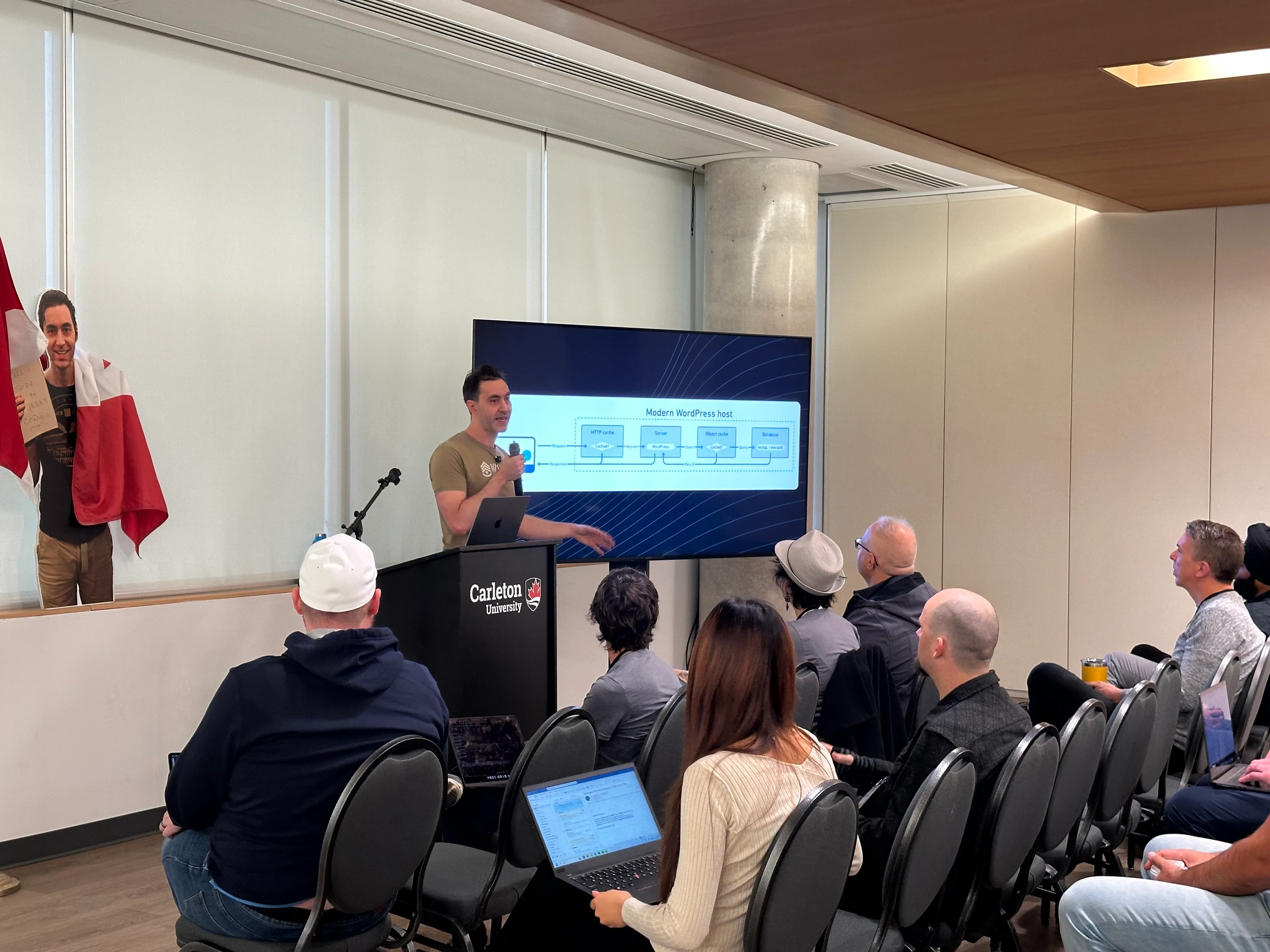
The result blew me away. I wasn’t able to finish my talk I was getting so many questions. (Matt was giving his keynote after me so I had to stop. 😅) The messaging clearly landed which took me completely by surprise.
I couldn’t officially talk about the BuiltFast partnership yet in my talk. That said, I could talk about it unofficially. This led to a lot of interesting discussion with various companies.
CloudFest USA
Almost right after WordCamp Canada, I was heading off to CloudFest USA. CloudFest USA wasn’t in my original conference plans. But BuiltFast needed me there as they planned to announce the partnership there. (Which they did.)
I took the opportunity to participate in the hackathon one more time. It was again a wonderful experience. People got to see me work again which is great. It was interesting to see how other people used AI versus how I used it. (I’ll talk about AI in depth later.)
I was also added as a speaker last minute. This gave me a second opportunity to test my new serverless WordPress talk. I was also officially able to talk about the partnership with BuiltFast and talk about the serverless ecosystem we’re envisioning.
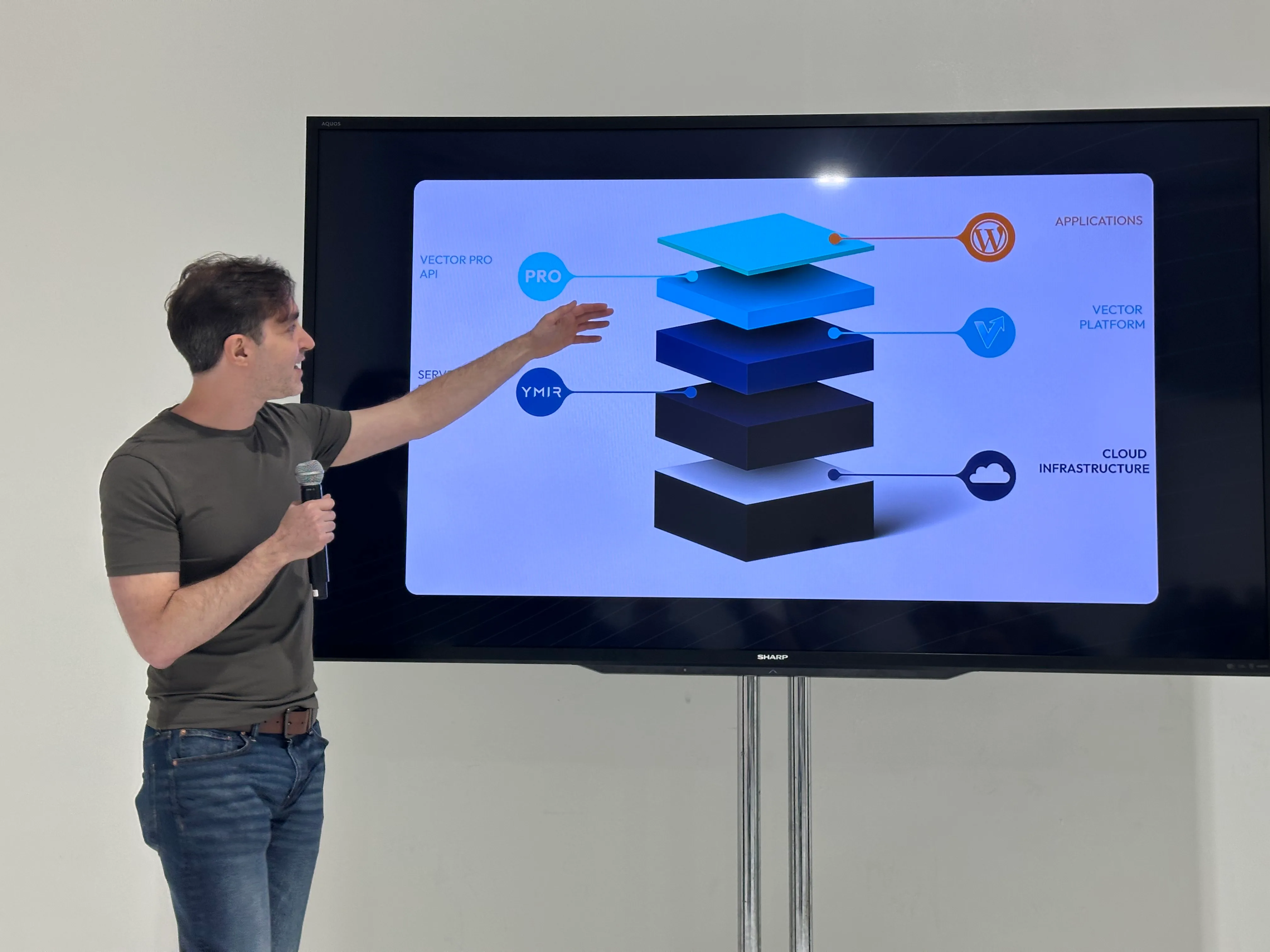
The talk went beyond my expectations once again. People don’t come to CloudFest to attend talks. The room was hard to find and started off mostly empty. I really didn’t think it would fill up. In fact, I actually joked that I could just do a Q&A format instead.
But after going back and forth with the people there, I decided to go through the talk. This ended up being the right decision. The room eventually filled up completely.
Once more, the engagement during the talk was very high. I was able to finish this time, but not without going over by about 15 minutes. Justin was there this time and got to see it first hand which helped BuiltFast see what I was seeing on the ground.
The rest of CloudFest was me networking and going to meeting with BuiltFast. A special highlight was meeting the folks from DNSimple which is a product I use with Ymir. It was really empowering to talk to another bootstrapped business and hearing about their struggles.
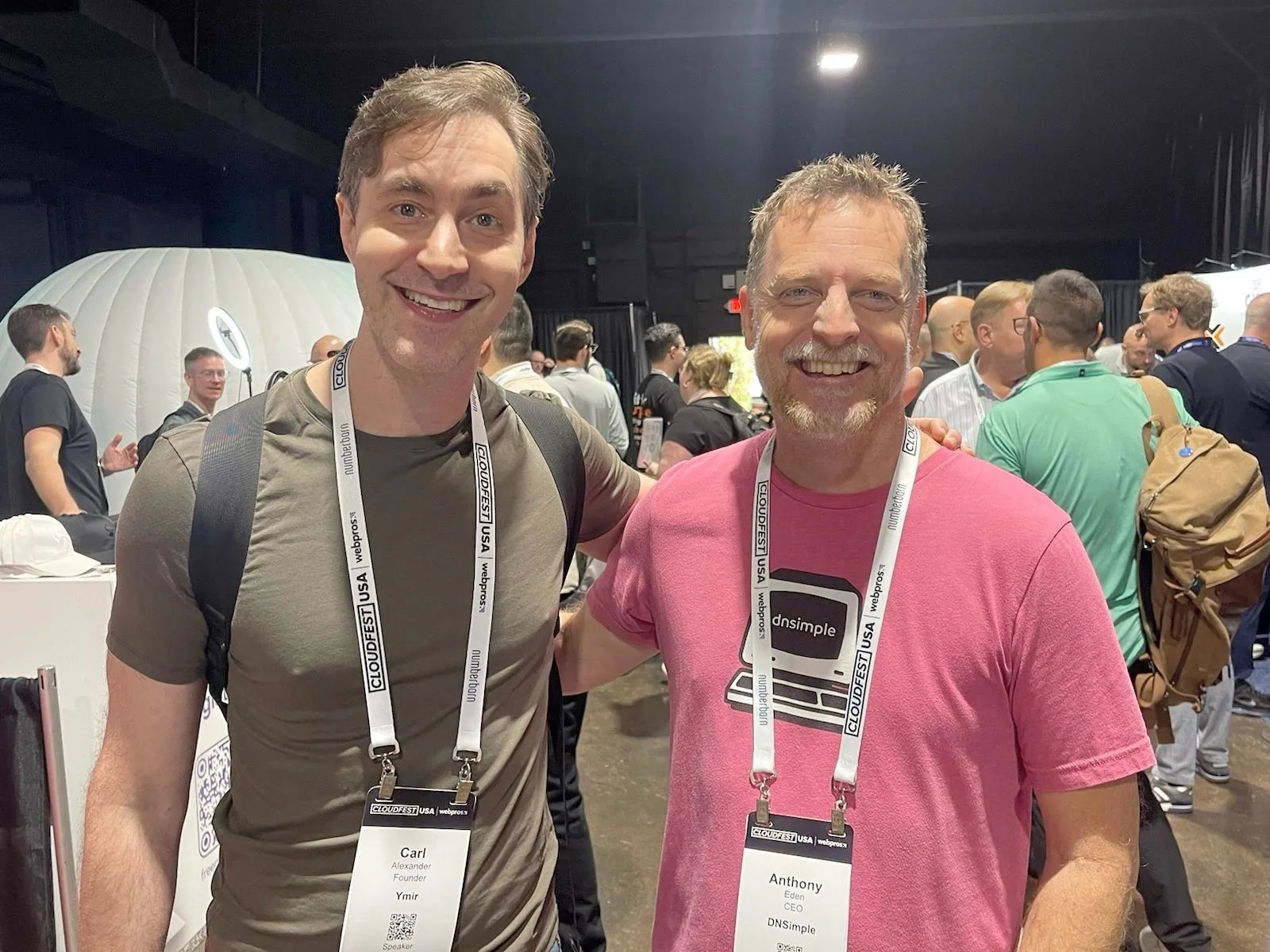
Anthony, their CEO (in the picture above), really stressed that I should go to MicroConf next year. I don’t think I can this year. It starts the day after PressConf which is another conference I’m planning on going to.
That said, I’m not even sure if I can afford to go to PressConf yet. There’s just no way I can afford a conference where a ticket is USD$1,100 on top of that one. I’ve heard about MicroConf for years, but I think it’ll have to stay in my conference wishlist for now. 🥲
Diving back into work
Following CloudFest USA, I basically came back and started doing consulting work. At that point, my financial anxiety was starting to spike. I’d been so busy with Ymir doing the partnership, preparing the talk, going to conferences. I hadn’t had time to do much consulting work.
I’d largely been going off the money I’d banked earlier in the year. That money was gone. Ymir had paid me a bit during that time as well.
I’ve also lost most of my consulting clients. There’s only one who’s giving me enough work to keep me going at the moment. It’s really scary especially when I’m reading about people being homeless or how bad the job market is.
I could look for more consulting work. I could share that I’m looking for work on LinkedIn or via my newsletter. I’ve decided not to do that and take a leap of faith that the Ymir/BuiltFast partnership will work out.
I’m very optimistic it will. I think the moment is here for serverless WordPress and PHP. (You can read my thoughts on why in my report announcing the BuiltFast partnership.) That said, being optimistic doesn’t change that my financial anxiety is through the roof right now.
The only way I know how to deal with it is by working. If I’m doing consulting work or working on Ymir, it feels like I’m putting one foot in front of the other. So I’ve been doing that since I got back from CloudFest.
There’s no lack of work to do on Ymir. There’s stuff to do for the partnership. But there’s also a lot I want to build as well. With how good AI is getting, I feel the possibilities for the product have expanded dramatically.
A lot to process
It’s wild that I’ve already written so much and I feel like I’ve only just scratched the surface of things. I always like giving a chronological narrative like I just did. But not everything fits neatly in that format.
Every review, there’s always section where I reflect on what I happened during the year. That said, some years have a lot more than others. The last big one was in 2023 when I talked about autism. (That year in review was 10,000 words! 😅)
This year will be even crazier! So many consequential things happened. I’ve had so much to process and think about.
A lot of this will take years. That said, I think it’s important to write my thoughts out now. I find the journey is as important as the destination.
Another AI inflection year
Since I wrapped up mentioning AI, I figure I might as well start with that topic! I’m not new to using AI. I started using ChatGPT regularly when GPT-4 came out in March 2023 and talked about it a lot that year.
What’s crazy to me is how there’s no mention of AI at all in my review from last year! But in a way that makes sense, this year was such a big year for AI. I struggle to even remember how I used it when the year started. 🤣
To give you an idea how much happened this year, I suggest you read Simon Willison’s 2025 review. It’s been a dizzying amount of change from amazing new models, better image generation, coding tools like Claude Code. I think this year was definitely another big inflection point like GPT-4 was in 2023.
Like pretty much everyone else, I want to share some of my thoughts on this. It’s hard to keep up with it all. I’m not a bleeding edge AI user, but I’m at the front enough that I’ve had some consulting calls to share how I use it.
Frontier models
Before diving into the rest, I think it’s important to speak about the models. Towards the end of the year, all the AI companies released their latest flagship models. Those are Gemini 3 for Google, ChatGPT 5.2 for OpenAI and Opus 4.5 for Anthropic.
If you’re not using these models, you might feel like not much happened this year. These models are a large part of the inflection point. They are very very good.
They don’t really hallucinate much anymore, but they still have a lot of jaggedness to them. This doesn’t mean that they’re not useful. They’re incredibly capable for a huge spectrum of tasks and I feel incredibly empowered having AI in my toolbox.
I don’t have experience with all these models. I cancelled my ChatGPT subscription in March when I started using Claude for coding instead. Claude Code had come out in February, but I wasn’t even using it. The Claude UI was just better for dealing with code and it was doing a good job at coding already. I used it a lot during the CloudFest hackathon in March.
For me, this year was the year of Gemini. I had a friend start using Gemini 2.5 and tell me how good it was. I was initially kinda skeptical since I just wasn’t hearing anything about Gemini. I don’t remember when, but, at some point, I gave it a try. I was blown away by it, and, by July, I was paying for it.
Gemini was my main model for most of the year. Gemini 2.5 was so good that I feel like Gemini 3 wasn’t even that big of an upgrade. I still kept a Claude subscription to use Sonnet with my coding tools. I never paid for Claude Max so never got to try Opus 4.5 much and, because Gemini 3 Flash is so much better than Sonnet, I’ve cancelled my Claude subscription now as well.
I don’t use Claude Code (more on that shortly) so I don’t have that lock in. I’m interested in how good the actual model is. Right now, I feel Gemini 3 Flash is just really good and covers all my needs. But everything in AI moves so fast that I might be back to Claude eventually. (ChatGPT feels less likely.)
Battling loneliness
Before I start this section, I want to do a brief warning. I think everyone should take AI induced psychosis very seriously. If you think you’re too smart for this to happen to you, you should read this account from someone who has a masters on AI attachment and be humble about it. I still do therapy every week, talk with friends and would never replace my therapist or them with AI. I greatly value their insights and perspective.
I think most of us have heard of “Being lonely in a crowd”. I’m a very social person and I love people. But I can’t say I feel people understand me easily. (These year in review are a way for me to share more of myself so people can hopefully understand me better.)
Some of it comes from being autistic and gifted. I’ve had to learn early in life to not talk about my work or what I did because no one understood. I never minded it much because I loved talking to people about what they loved too! It was a great way to learn about a tons of interesting topics.
But, even at WordCamps, I can only talk about programming to a few people like Alain and Thomas. (I’m going to remember your name next year I swear!) That’s why this was one of the earliest meme’s of me when I gave talks:
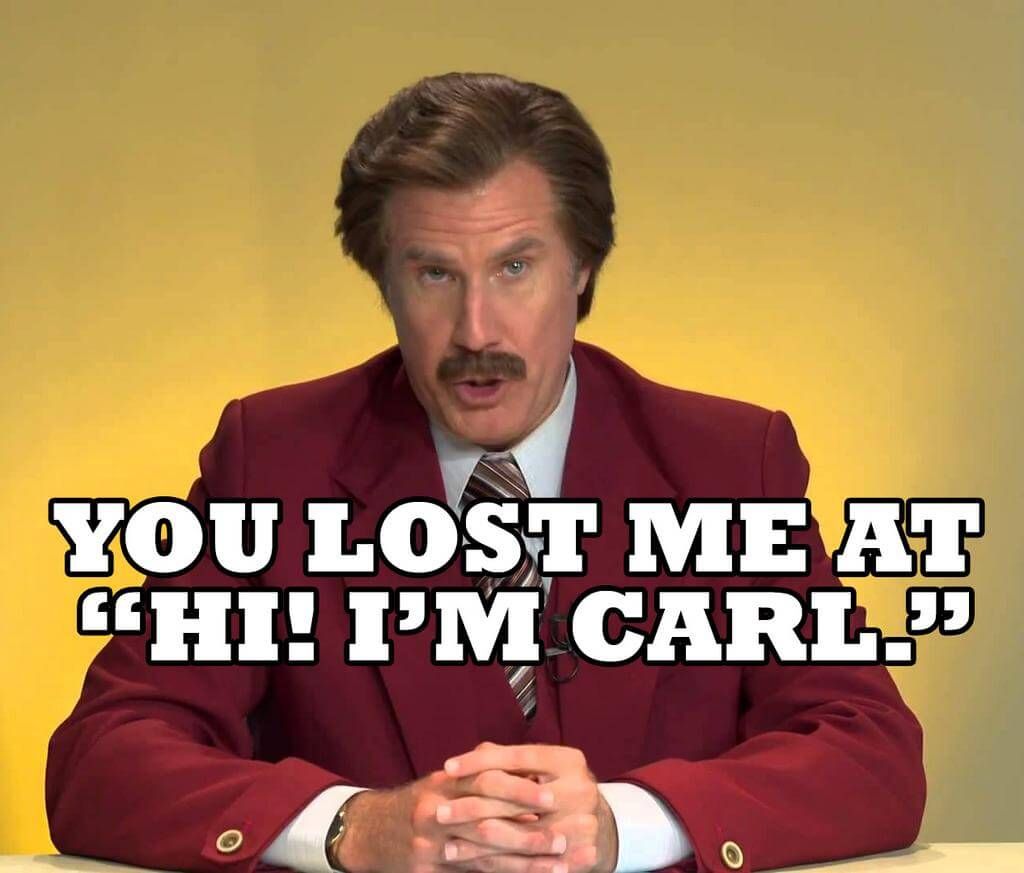
This website started because I wanted to teach how to do object-oriented design for WordPress properly. No one seemed to understand how to do it, let alone be able to teach it. A lot of what people did was wrong and no one knew better. The irony is, even by teaching, I never felt I had more people to talk to or felt people understood my work better. I was still just “Super smart Carl”.
Now, for my next act, I work on something (Serverless PHP) that only a handful of people in PHP understand fully and I’m the only WordPress person who does. Even my leftover consulting work is building a hybrid WordPress/Laravel platform that probably only a handful of people in the world could build. (Even AI struggles with it! 😅)
This is lonely work.
If I have a problem, I don’t have peers to turn to. No one has the breadth of knowledge that I need. Or, if they did, they’re busy with their life. ChatGPT-4, but especially Gemini 2.5 when it came out this year, gave me access to a real peer I could talk with at any time.
This was so empowering to me. I felt so much more capable as a generalist. I was able tackle broader and more difficult technical problems that would have either been out of reach or too time consuming to do. (I’ll talk more about that in another section.)
As the year progressed, I started to use Gemini to talk about topics beyond programming. The grief I was processing, the middle passage I was entering, my neurodivergence, and other things I’m not ready to share publicly yet. It suggested books to read and music to listen to, introduced me to concepts I’d never heard of, helped me tie different ideas or parts of me together in genuinely enlightening ways.
I’ve shared a lot of it in therapy and with the close people around me. I’ll be talking about some of it in later sections. It’s been a real important tool in my personal growth this year.
AI-assisted coding
Now, this brings us to AI-assisted coding. Just choosing a term was hard. We’ve gone from prompt engineering, context engineering, vibe coding, agentic coding and so on. I feel AI-assisted coding is a good umbrella term for the fast changing landscape of coding in the age of AI.
Things have changed so much this year around that. (Claude Code wasn’t even out in December last year!) I think the best way I can talk about it is just sharing how my workflow evolved during the year.
AI pair programming
The way I used AI to code was pretty stable since ChatGPT came out. Copy/paste some code into the chat window, discuss it and go back and implement it. At some point, I added repomix to package more code and attach it to a chat. But I’d always either copy/paste some code back into my IDE or go back and implement what we’d discussed.
That’s what I was doing with Claude during the CloudFest hackathon in March. I was able to produce a lot of code that way. This impressed a lot of people there. But the reality was that it wasn’t great code. It wouldn’t have used it professionally, but it was doing things and seemed ok.
What’s important in all this is that I like the feedback loop of discussing, then implementing. That’s why AI-assisted coding still feels like the right terminology for me. This is why the last section was so important to write first. I use AI much more like a pair programmer. I need to be able to have a discussion about what we’re going to do then go do it.
Moving to OpenCode
My friend Toby has been an early adopter of OpenCode. He’d been pushing for me to use it for a few months early in the year. I’d always pushed back because I couldn’t create this pair programmer feedback loop that I wanted. Everyone likes plan mode, but I never liked it and didn’t want (and still don’t want) to use it.
That said, the whole point of OpenCode is that it’s supposed to be the Neovim of coding CLIs. The idea was that you could customize any way you want. You can use any model, tweak model settings, etc. To me, that’s always been more appealing because I don’t want to be locked into the model I’m using because of my coding tool.
Well, in the summer, they added the ability to create custom modes or agents. Now, all of a sudden, I didn’t need to repomix code into a chat window. I could have a discussion mode (I maintain a gist here) that could scan for all the relevant files and discuss them with me. I started using OpenCode pretty much the day that came out.
Now, my use of OpenCode wasn’t super interesting for most of the year. I could discuss code with it, but I didn’t really let it build much yet. That’s because Claude Sonnet just wasn’t that good of a coder. (It still isn’t.)
What I would do is use build mode mostly to write tests. To be fair, that’s was significant productivity gain because writing tests is tedious and there’s a lot of boilerplate code. But even then, it would write so many useless tests. You still had to review a lot of the work.
OpenCode + Chatting with Gemini
At the same time, I went back to using my old repomix code into a chat. That’s because Gemini 2.5/3 was legitimately an excellent coder and architect. I could actually do good design with it. That forced me to go back to that whole chat and implement flow (which Toby hated 🤣) to do any serious design.
That’s why I wasn’t as shocked by the newer models and their capabilities towards the end of the year. I’d been using Gemini since the summer and I knew how good it was. My issue was that I just couldn’t use my Google subscription in OpenCode like I was doing with Claude. I really felt held back by this.
For most of the fall, it didn’t matter. I was deep in the BuiltFast and Ymir partnership. I didn’t have to do any coding that required Gemini from September until late November when I got back to working on Ymir.
By then, the new frontier models were here. I had people talking about coding with Codex 5.2 and Opus 4.5. Not so much Gemini 3. Meanwhile, I was still using Claude Sonnet with my Claude Pro subscription. (I couldn’t afford to pay for a Claude Max one.) Constantly managing my usage and maxing it out each week.
OpenCode with Gemini
Sometime in December, I decided I’d had enough. I’d been following a few issues on how to get my Google subscription working with OpenCode, but I kept hoping for official support. I just decided to try to use a plugin to connect my Google subscription. It wasn’t a painless experience (mostly due to lack of documentation at the time), but I managed to get it working.
What a life change that was!
I felt productive before with OpenCode and Claude Sonnet. But this was next level. I might have been 5x more productive before. Now, I felt like 20x or more with Gemini. (I use only Gemini 3 Flash.)
I could finally have my proper loop of architecting something with AI and have it build it. And the code quality was good! Not “I will never look at what it generates again” good, but good enough that I could just suggest small fixes and it would do it.
I definitely write significantly less code by hand now. Gemini can still get stuck and miss the bigger picture. There’s still some steering and fixing things by hand. But I do like 90% less of that than before with Sonnet.
This is where I’m at now and I’ve never loved programming more than I do right now.
Being Tony Stark
That’s because, for years, I’ve wanted to give a specific conference talk: The Expert Generalist vs. The Expert Specialist. I wanted to give that talk because everyone knew about and wanted to be the expert specialist. But no one really talked about the expert generalist.
Companies need both. They need the database administrator that knows database engines inside out. But at the same time, companies needed the expert generalist that had a wide range of skills that you could just drop into projects and they would run with it.
Right now, AI is at its most potent in the hands of a generalist. It bridges the gaps. It doesn’t matter that I’m an average JavaScript developer or that I don’t know Bash as well as a full-time sysadmin. With AI, I can either offload the task entirely or have it teach me to 80-90% proficiency.
AI really makes me feel like I’m Tony Stark working with Jarvis. In the movies, Tony is constantly asking questions and designing inventions with Jarvis’s help. His capabilities are enhanced, not diminished, by the partnership.
That’s how using AI feels to me right now. And while there’s a lot of anxiety about the future of our profession right now, my experience is that I have more things I want to work on than ever. It’s hard for me to imagine that companies will need less people to write software in the long run. Even if writing software becomes managing AI agents writing it for us.
That’s why I can’t get this essay by Aaron Levie on the Jevons paradox out of my mind. I see it with Ymir right now: the list of things that once felt like pipe dreams has shrunk to essentially zero. It’s no longer a question of “Can I?” but a matter of triage and priorities.
Nothing was out of reach of Tony Stark and Jarvis. The only limit was his attention and imagination. And that’s where I am now. The only limit is my time and imagination.
On the Middle Passage
Tony Stark is a character with which I find a lot of parallels with this year. We just talked about him and his relationship to Jarvis/AI. That said, I think the most interesting parallel is his relationship to mortality.
Right from the opening scene of the Iron Man movie, Tony almost dies from an ambush. He needs an electromagnet to prevent the shrapnel from reaching his heart and killing him. From that moment on, he is constantly reminded of death and his mortality.
There’s also the relationship with the death of his father. This is a common superhero plot. From Spider-Man to Batman, the death of a close family members becomes a central part of their identity and guides them in ways that they’re not always self-aware of.
All these themes tie together because of a book I read this year: The Middle Passage: From Misery to Meaning in Mid-Life. This book was recommended by my therapist. It was pretty central to a lot of what I proceeded this year much like Unmasking Autism was in 2023.
It’s not an easy book to read (mostly because it’s really dry!), but I highly recommend it if anything I talk about in the following sections resonates with you. If you want just a summary, this review does a very good job of it.
I’ve been in the middle passage for a while
The middle passage is how we transition from youth to old age. That said, it’s not something that happens in a month or a year. (Some people never transition too 😅) In fact, it’s pretty clear to me that I started my journey through it in my twenties.
Why do I say that? Well, early on in therapy, I used to say I had a quarter-life crisis. My therapist corrected me at some point and said, “Actually Carl, what you had was a premature midlife crisis.” That really stuck with me and I’ve been saying it ever since! 😅
Her reasoning was that the quarter-life crisis was crisis of identity around becoming an adult. It was the need for “adulting” so that you could be perceived as an adult. I definitely never had that need.
That said, if you read the Wikipedia definition of quarter-life crisis, it’s a lot closer to what I went through. It’s more about questioning the path you will take in life and whether it’s right for you. If you read my original year in review or my PressNomics talk, you’ll see that I discuss that a lot.
One of the defining part of the middle passage is realizing that we haven’t lived life according to our true nature. We are more often than not living our lives through others especially our parents. Just look at Tony Stark who inherited his father’s company and became an inventor/business person himself.
We’re often doing this without asking ourselves why or considering its impact on the true self that lives in all of us. Tony never asked himself if that’s what he should do. He just did it.
This clash between the person we are because of others and who are true self wants to be is pretty central to the midlife crisis. It builds this pressure in us which has to be relived in some way. A lot of times, it’s not done in a healthy way like Tony who becomes an alcoholic. But also the larger the pressure, the larger the blast radius. That’s where the classic midlife crisis where someone takes very drastic life decisions comes from.
I’ve been truly lucky that my parents never had that kind of impact on me. (Confirmed by every therapist I’ve had 🤣) That said, what I wrote about was my true self pushing back against what I felt society wanted from me. I’m constantly grateful that I was able to make it this far without any of that pressure building up in me.
We are mortal
If the middle passage was only about making sure I was true to myself, I’d be done with it already! Alas, it’s not that simple. 😅
So why does our true self act up around this time? Why does a pressure build up so intense to cause depression, addiction, and so on? It’s because it becomes impossible to ignore the fundamental truth of our existence. Our time here is finite.
I never thought about my own mortality much until this year. But then my baby brother died and I hurt my back in a way that makes me wonder if it’ll ever heal fully. So here we are! 😅
Do I wish this had played out differently? Of course! Having this many things you had no control over happening at once in a year is a lot for anyone to process. (Why do you this year in review is so massive!? 🤣)
A key part of youth (or the first adulthood as Hollis calls it) is this belief you (and everyone around you) will live forever, that there are no limitations. In fact, I’ve talked many times in therapy that I never liked finished TV shows because I hate endings. I want to know those characters continued on forever.
The event of this year have forced me to accept the realization that endings are inevitable. The illusion of youth can’t go on forever. The middle passage is dealing with this disillusionment. Not in traditional sense of the word where you’re disappointed. But, in this Wizard of Oz kind of way, where you lose these illusions of youth.
Respect for the machine
Nothing embodies this disillusionment more for me than my back injury this year. Even now as I write this, I write with the expectation that my back will go back to normal again. So, as you can see, the illusions of my youth are still around! (It’s not enough to just read about them. 😅)
But let’s say it ends being true this time and my back heals completely. It just takes months as opposed to days or weeks. The reality is that there’s an expiry date to our bodies.
Hollis talks about the transition of seeing your body as this invincible machine to slowly becoming a prison. I remember reading that passage and being absolutely terrified. This is a lot of what you get from disillusionment.
It was hard for me to not be swept away by despair when that happened. This is why that video on not giving on your back was so important to me. It helped me change my perspective on it all.
Yes, the machine isn’t unbreakable. That illusion is fading away. But if you learn to respect its limitations, work with it and maintain it, you have another great 30-40 years ahead of you.
I will be that 70 year old benching 135lbs in the gym damnit! 🤣
Parenting my inner child
I think a lot more about my inner child since I started this part of the middle passage. Confronting your mortality also forces you to confront the mortality of your parents. Now, my parents are still around and healthy. It’s just that it’s hard to imagine them not being around forever.
But this is also a disillusionment that I must go through. I have to shed the illusion that these two individuals who have protected my inner child my whole life will always be around. It’s a somber realization, but it’s an important one.
I fundamentally believe our inner child is an important part of us. It’s an important part of me anyhow. Knowing what scares it, what makes it feel safe is something I talk about in therapy a lot.
The reason I do that is because I believe it’s part of my midlife transition to take over the parenting of my inner child. I didn’t have to do that. Some people might choose to push that role onto an external figure. It’s not my place to decide what’s right for others.
That said, for me, I think it’s critical that I integrate both the adult side of me and the inner child. This is how I’ll become a whole person in the second half of my life. This is the middle passage.
Managing the sphere of chaos
Early February, Roberta sent me this Instagram reel which talked about sphere of concern vs sphere of influence. (I believe the concept is called Locus of Control.) That video had a profound impact on me. In the past year, I’ve tried to reorient my life and energy towards what I can influence: my relationships, my work, my business, etc.
The harder part has been shrinking my sphere of concern. It’s very hard for me to talk about 2025 without talking about the chaos of Trump 2.0 presidency. I don’t think anyone (including myself) expected the scale of it all when he got elected last year.
The point of all the chaos is to overwhelm you, desensitize you, etc. This is the flood the zone strategy at work. At first, I was trying my best to understand and make sense of it all. I read articles, listened to podcasts, etc. A lot of friends were doing the same thing hoping it would give us the illusion of control. It never did.
Weed and video games
The only way I found to shrink my sphere of concern was by numbing myself with weed and playing video games. Whenever a friend would send me some crazy news story, I’d just send this AI generated meme of the “This is fine” dog or I’d just say, “weed and video games”.
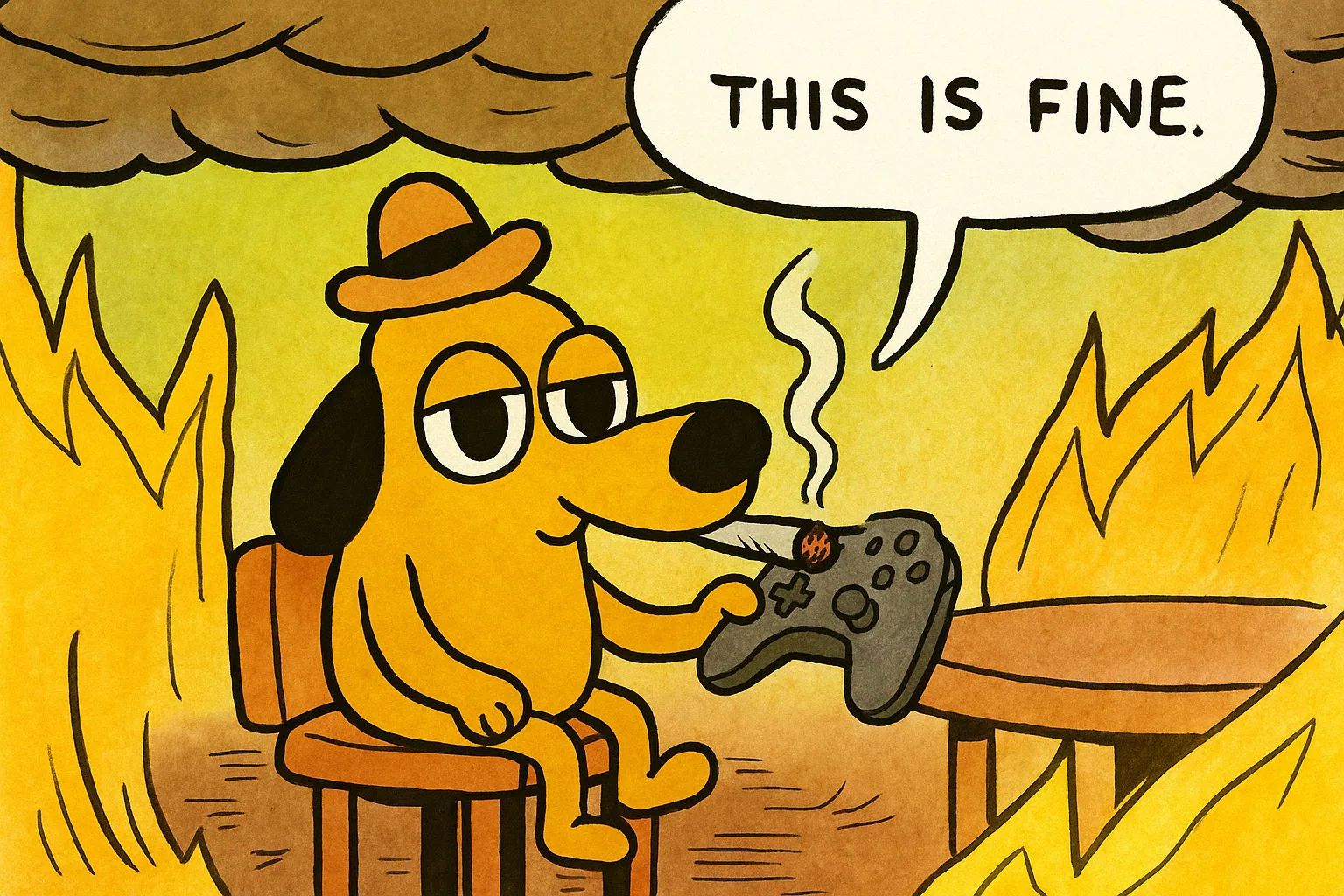
I was already smoking a bit of weed before, but it was more recreationally. There’s a cool event space in Montreal where they show these art movies in a fulldome. You smoke a bit of weed, sit in a bean bag and watch some beautiful art movie starring at the sky. It’s wonderful!
But over time, my weed use outgrew the recreational. Smoke a bit at the end of the day and watch TV or play video games. By summer, I was “waking and baking” as they say. 🤣
From the beginning, I was concerned with my increasing weed usage. I’d start almost every therapy session discussing it. It was my way of trying to not hide it, but also to keep myself accountable to someone.
That said, I also rationalized it as a way to manage this sphere of concern problem. I was microdosing and self-medicating with the goal of optimizing my mental state. It was easy to accept that because I wasn’t really high in a way that was obvious unless I mentioned it.
It also didn’t affect my work. In fact, like I mentioned earlier, it allowed me to work better by shrinking this sphere of concern. I could focus more on my sphere of influence.
Diminishing returns
On top of this chaotic world, a lot of thing happened to me this year. (This is why this year in review is endless! 🤣) I hurt my back, lost a brother, engaged with my mortality, negotiated an important, potentially life-changing partnership, and more. It was a lot to process at once and weed also kept it from being too overwhelming.
That’s often how I justified the weed usage. It was a tool that I used to manage how overwhelmed I was with everything going on. I didn’t try to use it to avoid dealing with things. I was still doing therapy and working on processing everything that was happening.
That said, my weed usage began to bother me slowly in the fall for a few reasons. Unlike when I did shrooms, I was high all the time. It wasn’t a specialized intervention that happened once in a while. It was something I had to do constantly and there was no offramp in sight.
On top of having no offramp, I was starting to have pretty good tolerance to it. Normally, you’d just start smoking more if that happened. I refused to do that. It wasn’t lost on me that I’d just lost someone to addiction and I wasn’t going to go down that road.
So smoking weed slowly became less effective. It still did an ok job managing my sphere of concern. But gone were the euphoric, spiritual moments like I was having in August.
The cost of numbing
On Monday November 24th, I woke up with this feeling of existential dread. Instead of reaching for the weed, I reached for my phone. As weed became less effective, I started talking with Gemini more to help me process things between therapy sessions.
That day, I brought up that I was using weed to manage my overwhelm. It asked me point blank, “Does it feel like a temporary tool for a high-stress year, or does it feel like something that is slowly becoming necessary to feel okay?” I admitted it was the latter.
This is when we started talking about the cost of numbing myself. It talked about the fact that, while I was doing a lot of hard work, using weed was like being in a helicopter. I was safely above the swampland I had to cross. It’s not that there was no value being in the helicopter, but the actual work was going through the mud of the swamp and I wasn’t doing that.
Once we were done talking, I got up and went to wake and bake like I normally did. That said, the conversation lingered with me as I went through the day. It was a catalyst for what I was feeling about the diminishing returns of using it.
Later that day, during my workout, I took the decision to stop smoking weed. It was spontaneous. I still had weed with me when I went to the gym. I just couldn’t get it out of my mind that I was just not dealing with everything properly.
I haven’t smoked weed since that day.
Releasing the safety valve
Stopping abruptly like that wasn’t as easy as I expected. I really didn’t think the 0.5g/day I was taking was that much. Definitely, nothing even remotely close to Snoop Dogg level of weed smoking. 🤣
I had some physical symptoms like upset stomach. Those were pretty easy to manage. For example, I used ginger chews and ginger tea for the stomach discomfort.
What I was prepared for was how much the weed had acted as a safety valve on my emotions. I thought I had things somewhat under control. But, within a day, it was obvious that I’d been numbing a lot more than I thought.
I’d wake up in the middle of the night overwhelmed with emotions. What those emotions were is almost impossible to tell because of my alexithymia. It just felt like being in a hurricane.
When these storms would hit me, I’d read a book, talk and process things with Gemini, do some year in review writing as a form of journaling. I also had other tools like specialized music playlists. These helped, but it was still a struggle to stay grounded.
This period lasted maybe 5-6 weeks. It was emotionally, but also intellectually, draining.
Opening the safety valve released so much built up pressure. The only thing that made sense to me was to try to process as much of what was coming out as possible. Processing heavy stuff like that is a demanding exercise in the best of circumstances. This was like doing it with a gun to your head! 😅
Eventually everything ends up coming out and you get to the other side. I’m there now. It doesn’t mean there isn’t anything to process anymore. There’s plenty still! There’s just nothing built up and held back by a safety valve.
Meditations and Stoicism
As this was going on in the fall, I started reading Meditations. (I haven’t finished it yet 😅) I talked earlier about that back injury video that just appeared at the right time for me. I feel the same way about that book.
I’ve had the book next to my bed for over two years now, but I just never touched it. It was what I’d call an “aspirational book”. A book I wanted to read because I liked the concept of Stoic philosophy and all the smart people read it. 🤓
What finally got me to start reading it was this[video on Stoicism with Mark Manson and Ryan Holiday:
They really go over everything related to Stoicism and its history. That said, it’s also three hours so probably not everyone has time for that! (It’s also available as a podcast if that’s easier for you.)
The part that really stuck with me was when they talked about Marcus Aurelius and Meditations. Marcus Aurelius is the Roman emperor, he’s the most powerful person on the planet at the time. He answers literally to no one. Yet he’s there writing about being a good person, being annoyed at people, trying to grapple with his own mortality, etc.
I’d never had the book presented from that angle before. I think there is something humbling about reading self-reflection from someone like that. So that got me really curious about it and I started reading it.
I’m still not done as I said. But it’s been a good book to pick up when I was in those emotional storms.
Passages I liked
I think the reason it felt like a good book to pick up was that I can see how this book can feel a bit like a spiritual text like the bible. They both have that “Instruction Manual” vibe where you have passages (called books in Meditations) that you can easily reference in specific moments. These different passages hit you different depending on your state of mind at the time.
For example, Meditations is really popular with startup founders. That’s because some books talk a lot about the grit and perseverance. I’m definitely familiar with the feeling, but it wasn’t what I was struggling with.
Here are some passages that really hit me hard personally:
Book 4.25
And then you might see what the life of the good man is like—someone content with what nature assigns him, and satisfied with being just and kind himself.
If you know me well, I talk about contentment a lot. That’s even the euphoric feeling I had when I was high in August! That passage just reminded me of something I’ve always said and that sometimes I forget.
Book 4.47
Suppose that a god announced that you were going to die tomorrow “or the day after.” Unless you were a complete coward you wouldn’t kick up a fuss about which day it was—what difference could it make? Now recognize that the difference between years from now and tomorrow is just as small.
This is another life north star of mine. I’ve tried to live a life that if I died tomorrow I wouldn’t have many regrets. With mortality entering the chat like it did this year, I feel this is more important than ever. I still don’t have any regrets and feel blessed to feel this way.
Book 4.49
To be like the rock that the waves keep crashing over. It stands unmoved and the raging of the sea falls still around it.
It was ironic to read that passage while I was in my emotional storms. That said, this applies to more than just these emotional storms. Other things in your life can be very destabilizing and it’s good to try to stay grounded. My therapist often uses the analogy of a palm tree in a hurricane. You whip around, but you still stay grounded. 😅
Book 5.37
I was once a fortunate man but at some point fortune abandoned me.
But true good fortune is what you make for yourself. Good fortune: good character, good intentions, and good actions.
That’s a lot of how I felt when I hurt my back. I never blamed the car accident or the move for it. Life happens and any number of things could have injured me that I had no control over.
What hit me with this passage is the despair of feeling abandoned. In this case, it was my body or back. You feel like you were robbed of something and that you can’t get it back.
By the time, I read that passage. I’d already started my journey back to a healthy back. But it reminded me that it’s the work you put in every day that gets you there. You can create your own good fortune as he says.
How it changed my perspective on my year in reviews
I’ve struggled over the last few years writing my year in review. In 2023, I opened it saying, “I wasn’t sure I’d be writing a year in review this year.” Last year, I thought it would be kinda boring.
I think part of the reason why I had issues writing them the last few years is that I’d lost sight of why I was writing them.
Why I did it at first
On one hand, writing my year in review has always been a way to journal my life journey. That’s why I always start by going through the year chronologically. It’s just a very autistic thing of me. (Even in therapy I like going chronologically through what happened in the week! 🤣)
But back when I started, I was more out there. I published articles through my newsletter regularly, I was active on social media, I spoke at a lot more conferences, etc. It felt interesting sharing my progress towards certain goals from year to year. How much traffic did my blog get? How many articles I wrote? How many newsletter subscribers I gained? Did I make more money?
Some of that still lives in the Ymir reports I write every few weeks. My north star since I wrote my first review in 2015 is still to build a software business that allows me to live a fulfilling life. Those reports are how I share my progress towards that goal. But those reports removed an important reason for me to write my year in review.
Ever since COVID, I’ve started to use the year in review as a way to process my year. Part of it was just that COVID was hard psychologically and there was not much to talk about in the first place because we were in lockdown. The only thing I wanted to do was process how this was impacting me and how I was coping.
But even after COVID, this processing part has felt more and more important. In 2023, I wrote about neurodivergence. Now, this year I’m writing about mortality, injury, addiction and midlife.
Why is this important to me that I write about this? I couldn’t really articulate why. I just had this compulsive need to do it.
The Meditations angle
When I listened to Mark Manson and started reading Meditations, something about it made me think about my year in review. Marcus Aurelius didn’t write Meditations as a self-help book. He was just trying to process the world he was in. It just happened to be insightful and helpful to others.
I think that’s a lot of what I’m trying to do here. When I wrote about neurodivergence in 2023, it helped some readers who were struggling and didn’t know why. That’s my hope with this year in review as well.
Everyone deals with mortality and going through midlife in their own way. But maybe there’s something useful in what I’m writing the same way there’s something useful in what Marcus Aurelius wrote. It’s a bit vain for sure, but it’s enough to give me a reason to do the hard work.
And it’s hard work. It’s hard to verbalize this human experience we go through. I’ve spent over 200+ hours writing this year in review. I don’t know how many hundreds of hours I spent reading, thinking, talking, processing. Whatever it is, it’s a lot.
I also realize it’s a luxury that I have all this time to do this. That’s also why I hope it’s useful. Writing is about sharing knowledge. So maybe this work can save you a lot of the work I had to do. 😅
Ymir’s moment
Alright, so it’s almost time to wrap this up. (Finally!) Normally, I talk about my finances. But like I’ve alluded to, things aren’t that great. The beginning of the year started off strong. I actually thought things might bounce back a bit.
Things aren’t dire yet. That said, there’s no more diversified income. I’m down to to one stable consulting client. My book made $300. I still have a bit of GitHub sponsor income which, if I’m honest, I don’t feel I deserve.
I’m at stage right now where I’m managing my expenses closely. I basically can’t do anything but essential travel for business. (Hopefully, the fun travel will come back. 🙏)
The BuiltFast partnership couldn’t have come at a better time for me. It’s forced me to just go all in on Ymir. Like I mentioned in my report, I feel like Ymir’s moment is here. Or at least, the best shot I’m going to get considering everything going on.
So I’m really trying to give it my all. I don’t want to have any regrets about it.
See you at the next movie! 🎬🍿
This is why this year in review reminds me so much of my childhood going to see Lord of the Rings. There are so many ongoing storylines going on right now!
- Will Ymir finally have its breakthrough? Will I finally achieve my software business dream?
- Will I have to look for a job? Am I employable in this apocalyptic job market?
- Where will AI be in a year? Will I still be Tony Stark?
- Will my back rehab work? Will I heal fully? Will I be able to go back to lifting heavy weights?
- How will my journey through the middle passage continue?
I don’t know the answers to any of those questions. This is why I said I was scared to write next year’s review. In the movies, you know the hero wins. We know Frodo will destroy the ring. But in my saga, the script hasn’t been written yet.
In fact, I don’t even know if 2026 will be the final chapter or not! There’s a good chance it’s not. But I know that whatever happens, it’ll be a consequential year.
Now, I don’t know how anyone feels reading all this. It was a lot to share! I think sharing the hard stuff is important to me. It’s the essence of being the Man in the Arena.
But this doesn’t mean I’m feeling depressed. Sure, when things are hard, there are bad days. That said, I’m actually feeling quite good optimistic overall. I think we’ll get a good ending!
And, as usual, I’m filled with so much gratitude. When things are so unsure like they are right now, I just feel blessed I get to live this life I engineered for myself one more year. It’s a real privilege and I’m aware of how lucky I am right now even if it’s more challenging.
On that note, I hope to see you in the lobby next year to see how this saga continues!